
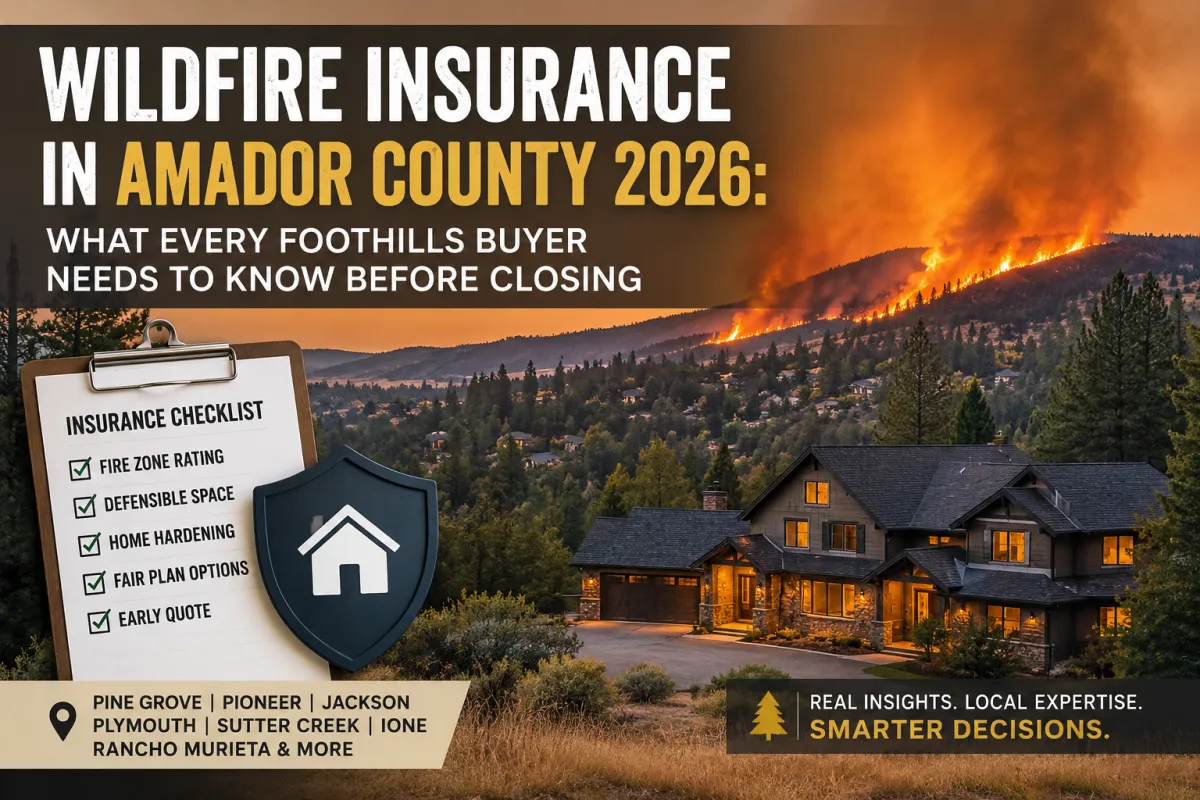
Wildfire Insurance in Amador County 2026: What Every Foothills Buyer Needs to Know Before Closing
Last summer I had a buyer in escrow on a beautiful 4-acre property off Ridge Road in Pine Grove. Three weeks before closing, his insurance application came back with a quote that nearly doubled what he'd budgeted. State Farm wouldn't touch the property. Allstate had pulled out of high-fire-risk California zip codes the year before. The only viable option was a California FAIR Plan policy plus a wraparound difference-in-conditions carrier, and the combined annual premium was $4,800 — on a $480,000 home.
He didn't walk. But he came within forty-eight hours of doing it, and that's the conversation I have with almost every Amador County buyer now.
If you're shopping anywhere in the Sierra foothills, insurance isn't a closing-cost line item anymore. It's the deal.
The 2024–2025 Reality
Major carriers — State Farm, Allstate, Farmers, USAA — have either stopped writing new policies in high-fire-risk California zip codes or are non-renewing existing policyholders. That's not a rumor. State Farm's 2024 pullback affected over 70,000 California properties, many of them in counties exactly like Amador.
What that means for buyers here: you cannot assume you'll get insurance. You apply, and you wait. If you're denied — and many properties in Pioneer, Pine Grove, Plymouth, and the higher elevations of Jackson get denied — your only option is the California FAIR Plan, the state's insurer of last resort.
Fire Risk Varies Inside the County
Amador isn't one risk pool. Cal Fire's Fire Hazard Severity Zone maps grade properties as Moderate, High, or Very High. Roughly:
Pioneer, Buckhorn, Volcano, upper Pine Grove: mostly Very High
Lower Pine Grove, Sutter Creek hills, Jackson outskirts: mostly High
Downtown Jackson, downtown Sutter Creek, Ione, Plymouth: mostly Moderate
Rancho Murieta: Moderate (master-planned with managed fuels)
Your specific property's rating matters more than your town's rating. Pull the Cal Fire map for the exact address before you write an offer. I do this for every buyer client before showings.
What Insurance Companies Look At
Three things move premiums up or down dramatically:
1. Defensible space (the 100-foot rule). California requires Zone 0 (0–5 ft, ember-resistant), Zone 1 (5–30 ft, lean and green), and Zone 2 (30–100 ft, reduced fuel) maintenance. If the previous owner let brush creep within 30 feet of the house, you'll inherit that problem and that premium.
2. Home hardening features. Class A composition or metal roof, ember-resistant vents, double-pane windows, enclosed eaves, non-combustible siding within 5 feet of the home. Properties with these features qualify for the California Wildfire Safety Regulation discount under AB 2238 — often 10–20% off the premium.
3. PSPS history and access. PG&E's Public Safety Power Shutoffs aren't insurance-rated directly, but underwriters look at the property's access (one road in or two), proximity to fire stations, and water source (hydrant vs. tank).
Where to Get a Quote — Actually
For high-risk Amador properties in 2026, I send buyers to local independent agents who write multiple FAIR Plan and surplus-lines carriers. Captive agents (State Farm, Allstate) can't help with anything beyond their own underwriting box. Get a quote in writing before your contingency deadline. Don't wait for the loan officer to ask you.
The Bottom Line
I closed 21 buyer transactions in 2024, and at least 14 of them had insurance complications. The Bay Area buyers especially feel this — they're moving here for affordability and the foothills lifestyle and they get blindsided by quotes 3x what they paid in Marin or Contra Costa.
The fix isn't to skip the foothills. The fix is to budget insurance correctly, time your application early, and work with a Realtor who runs the Cal Fire zone check before the listing tour. If you're relocating from the Bay Area, this is the single biggest cost surprise you need to plan for.
Call me at (209) 401-9912 before you write your offer. I'll pull the property's fire zone, recommend three local independent insurance agents who actually return calls, and tell you upfront whether the home you're falling for is insurable.





Disclaimer: All information contained on this website is deemed reliable but not guaranteed. All properties are subject to prior sale, change or withdrawal notice goldrushrealtygroup.com believes all information to be correct but assumes no legal responsibility for accuracy.